


What's new: Openlayer named in the 2026 Gartner Market Guide® for AI Evaluation and Observability Platforms. Learn More

Every AI system in your company.In one place.Under control.

The AI governance platform that tests before you ship, monitors what's live, and enforces policy in real time. Audit-ready evidence comes standard.

See what full control looks like
Trusted by fortune 500 AI teams
Creditas
Rootly
Jericho Security
eBay
Sun Life
Comcast LIFT Labs
DIRECTV
Telefónica
Gallagher
Amdocs
Globo
KPN
UTMB Health
Sky
Virtu Financial
Openlayer
Results
Create Project
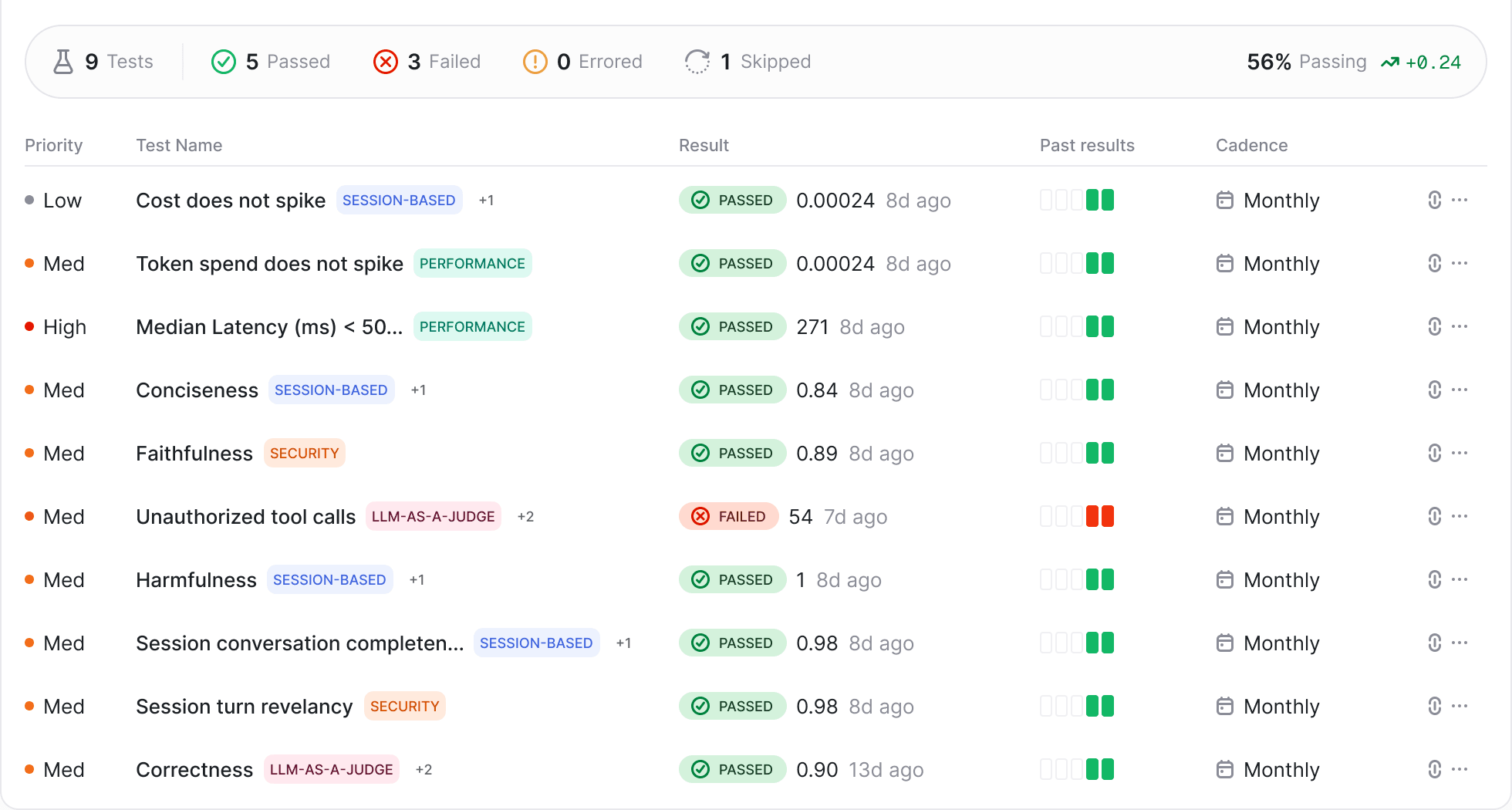
9Tests
5Passed
3Failed
0Errored
1Skipped
56%
Passing
+0.24
Tests
Create tests
Search tests…
K
Priority
Test Name
Result
Monthly
Low
Cost does not spike
Session-based
+1
Passed
0.000248d ago
Monthly
Med
Token spend does not spike
Performance
Passed
0.000248d ago
Monthly
High
Median Latency (ms) < 50...
Performance
Passed
2718d ago
Monthly
Med
Conciseness
Session-based
+1
Passed
0.848d ago
Monthly
Med
Faithfulness
Security
Passed
0.898d ago
Monthly
Med
Unauthorized tool calls
LLM-AS-A-JUDGE
+2
Failed
547d ago
Monthly
Med
Harmfulness
Session-based
+1
Passed
18d ago
Monthly
Med
Session conversation completen...
Session-based
+1
Passed
0.988d ago
Monthly
Med
Session turn revelancy
Security
Passed
0.988d ago
Monthly
Med
Correctness
LLM-AS-A-JUDGE
+2
Passed
0.908d ago
Monthly

Your teams are shipping AI.

Your controls are notkeeping up.

Copilots, agents, and models are going to production across every business unit. Most companies can't list them, few can test them, and almost none can prove to a regulator what any of them did last Tuesday.

88%

of AI agents built never make it to production due to governance and eval gaps

Source: S&P Global, 2026

79%

of enterprises do not have a governance model for the AI agents they are already running

Source: McKinsey, 2026

$207M

is the average projected AI spend per US enterprise over the next 12 months

Source: KPMG, Q1 2026

Control your AI,layer by layer.

Each layer delivers value on its own. Together, they turn scattered AI into systems you can govern, observe, and prove are under control.

Discovery

Layer 01

Know what

AI you have

Know every AI system running, org-wide inventory and automatic shadow-AI detection.

You can’t govern what you can’t see, so this is where control begins.

Explore Discovery
What you get
  • Org-wide AI system inventory
  • Integrations with all major ADKs
  • Automatic shadow-AI detection

Registration

Layer 02

Catalog and

assess risk

Turn a raw inventory into an accountable registry.

Register each system with its owner, purpose, data sensitivity, and risk tier using intake and risk-assessment forms you build to fit your policy.

Explore Registration
What you get
  • Central AI registry
  • Custom intake forms & lifecycle management
  • Model & dataset versioning
  • Risk assessment & tiering

Testing

Layer 03

Catch problems

before they ship

Build evaluation suites and run them pre- and post-deployment against your own data.

Benchmark every change and block regressions in CI, so quality is proven rather than hoped for.

Explore Testing
What you get
  • 175+ out of the box evals
  • Regression testing
  • CI/CD testing
  • Diagnostic tools & root cause analysis
  • Custom metrics

Observability

Layer 04

See what your AI

does in production

Trace every input and output. Monitor quality, cost, latency, and drift on live traffic, and get alerted the moment behavior changes — across apps you build and tools you buy.

Explore Observability
What you get
  • Monitoring for every deployment
  • Trace prompts, responses, tool calls, & more
  • Continuous online evaluation
  • Diagnostic tools & root cause analysis

Security & Guardrails

Layer 05

Protect AI in

real time

Protect AI in real time. Block prompt injection, jailbreaks, PII and PHI leakage, and off-policy outputs before they reach a user.

Enforce access and routing policies at the gateway, so every request is governed, not just watched.

Explore Security & Guardrails
What you get
  • Real-time control & guardrails at every step
  • PII detection & redaction
  • Policy enforcement & gateway routing
  • Custom guardrails & content safety
  • Prompt-injection & jailbreak defense

Compliance

Layer 06

Map frameworks and

prove compliance

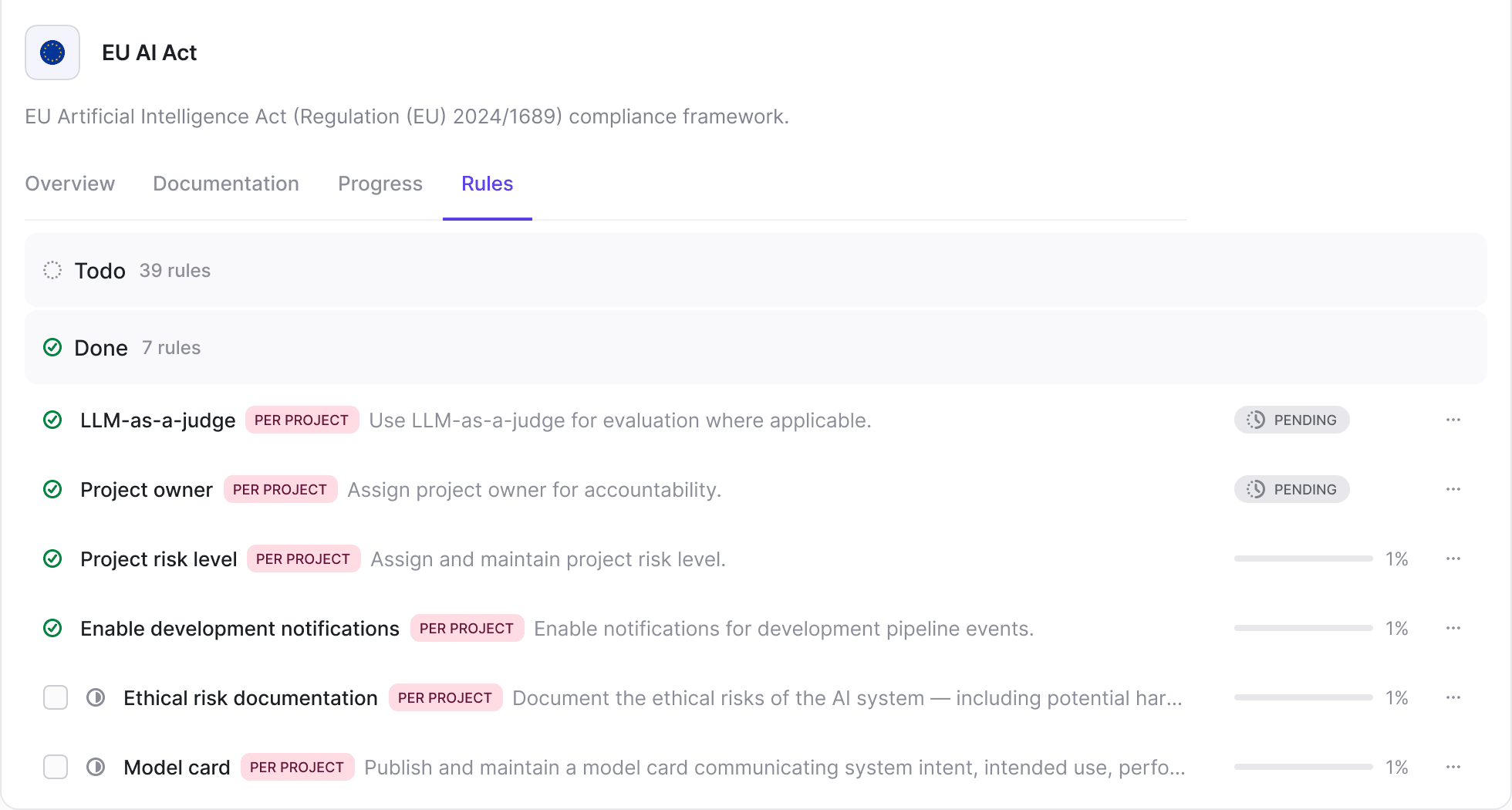
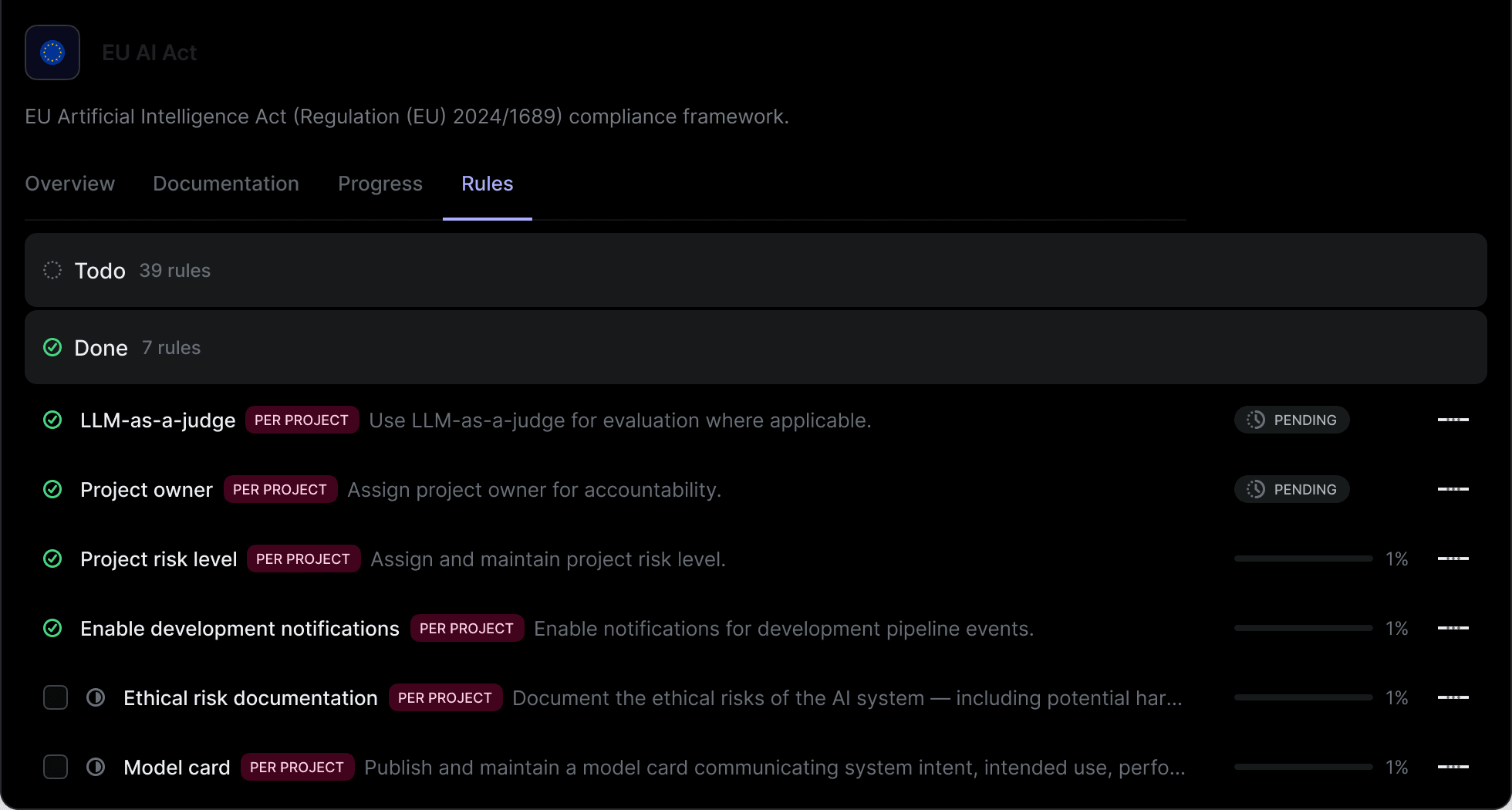
Map everything to the frameworks you answer to: EU AI Act, NIST AI RMF, ISO 42001, and your internal policy.

Compliance isn’t a separate workstream, it’s powered by every layer beneath it.

Explore Compliance
What you get
  • Framework mapping (EU AI Act, NIST, ISO 42001)
  • Control libraries
  • Audit-ready evidence
  • Controls for internal & external frameworks
  • Reporting & attestations

Cost Controls

Layer 07

Know and

control spend

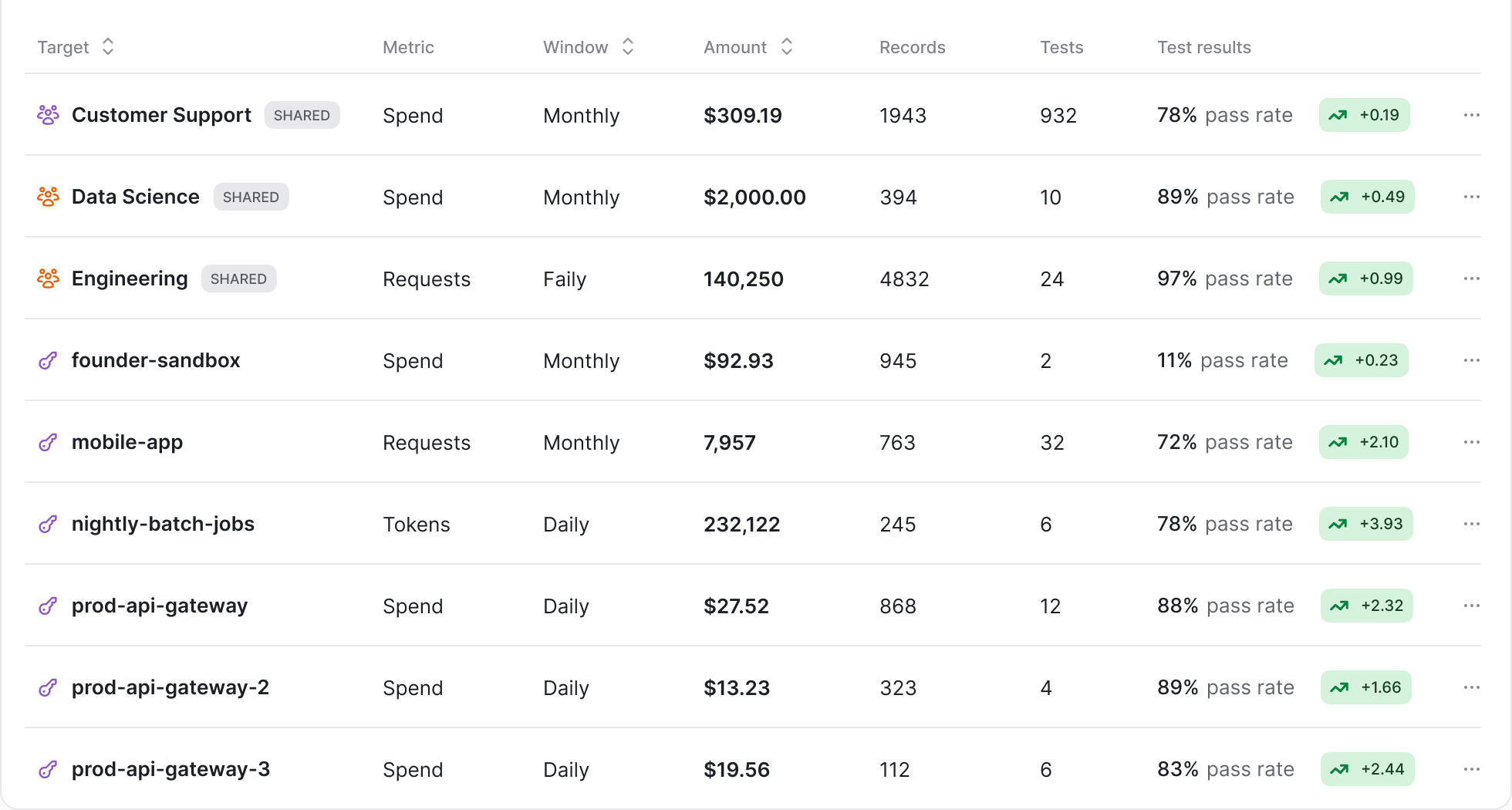
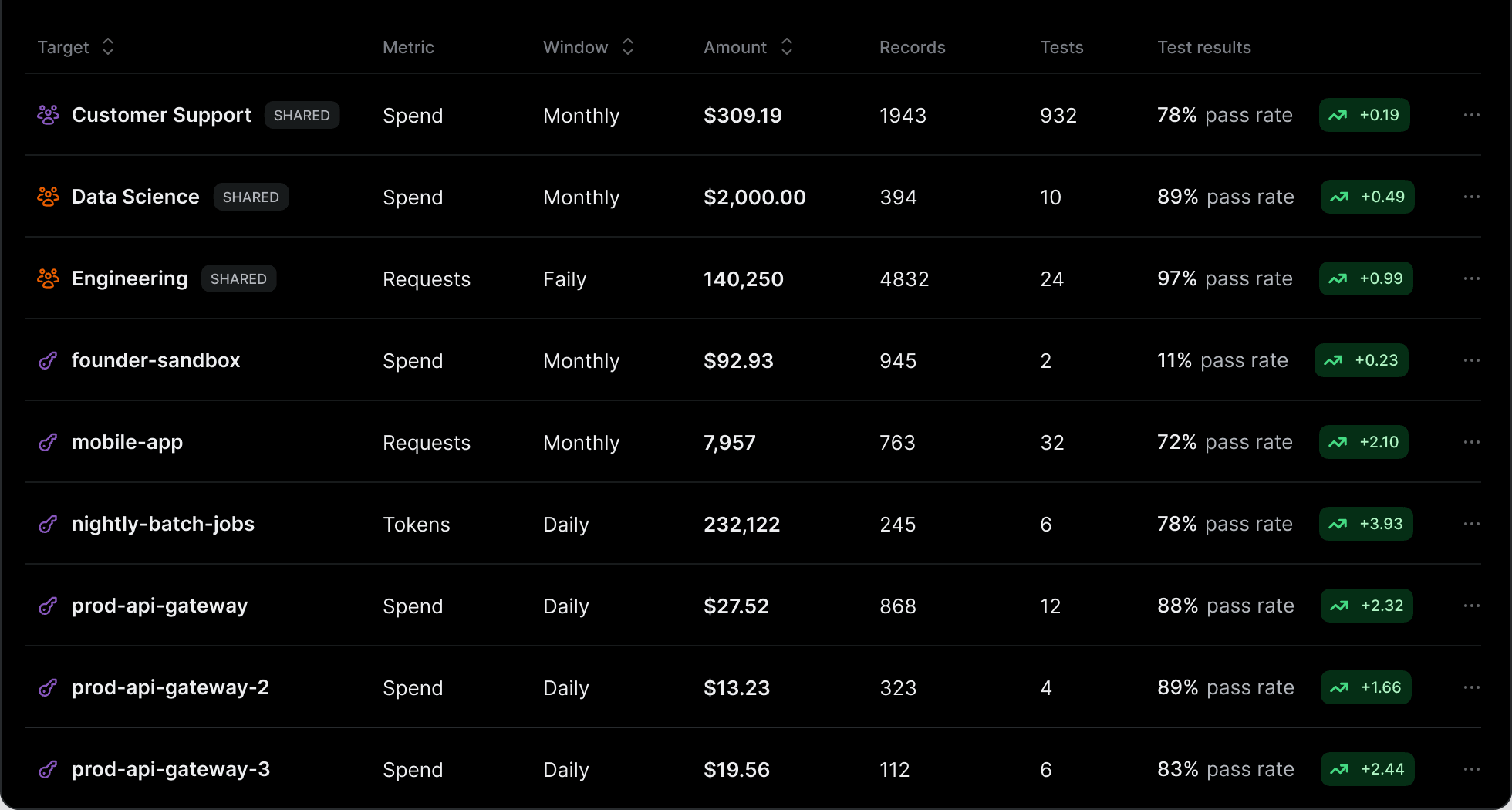
Know and control spend, token spend by project, team, and user, hard budget caps per API key or team, usage dashboards for finance and leadership, ROI visibility that ties spend to outcomes.

Explore Cost Controls
What you get
  • Token spend by project, team, and user
  • Hard budget caps per API key or team
  • Usage dashboards for finance and leadership
  • Protect against security flaws & vulnerabilities as they arise
  • Automatically route high-spend users to cheaper models
  • Avoid downtime when models go dark
  • Tie spend to outcomes & surface projects with no measurable return

What people are saying

“We were tracking 120 concurrent AI projects in SharePoint. It was not live, not connected to anything, and we had no way to know what any of them were actually doing.”
Head of AIMajor Hospital Group
“We have 80 AI tools, half from vendors, half internal. We have a governance council but no continuous monitoring. That is the gap we need to close.”
AI Governance LeadEnterprise Financial Services
“We can finally prove oversight without slowing down engineering.”
Chief Risk OfficerF500 Global Insurance Firm
“We have intake, but governance is still evolving. That's the hair on fire problem. We needed something that connects them.”
Head of AI GovernanceRegulated Financial Services
#01

6x

Faster from development to deployment

#02

90%

Reduction in audit preparation lift

#03

53%

Higher throughput withOpenlayer

#04

100%

Client renewal rate

Works across every AI source

Every major LLM provider. SDKs, CLI, REST API, Git, OpenTelemetry, and Snowflake. Vendor AI, homegrown agents, and classic ML, governed the same way.

Capability

Code you own

Traffic you can route

Connected vendor AI

Opaque vendor AI

Discover

Native
Native
Native
Native

Registration

Native
Native
Native
Native

Testing

Native
Native
Native
Vendor-dependent

Observation

Native
Via gateway
Via telemetry
Vendor-dependent

Security & Guardrails

Native
Via gateway
Vendor-dependent
Vendor-dependent

Compliance

Native
Native
Native
Native
NativeVia gatewayVia telemetryVendor-dependent
What is Openlayer?

Openlayer is the AI governance platform that helps enterprises build, deploy, and operate trustworthy AI systems. It gives teams one place to discover, test, monitor, govern, and optimize every AI system they run.

What problem does Openlayer solve?

Most organizations run AI systems that were never formally tested, are not continuously monitored, and cannot prove policy was actually enforced. Openlayer gives every AI system, built in house, purchased, or embedded in a vendor tool, a single place to be discovered, tested, watched, and governed.

How is Openlayer different from a typical AI observability tool?

Observability tools show what already happened. Openlayer also tests systems before they reach production and enforces policy while they run, so governance evidence is generated continuously as part of normal operations.

What does the Openlayer platform actually include?

The platform is organized around seven layers: Discovery, Registration, Testing, Observability, Guardrails, Compliance, and Cost Controls. The Gateway sits across these layers as the enforcement point, giving teams one place to route, monitor, and control AI traffic without rewriting applications.

Which AI systems can Openlayer govern?

Openlayer covers large language models, retrieval augmented generation pipelines, autonomous agents, traditional machine learning models, and multimodal systems, whether they were built internally or purchased from a vendor.

Do I need to rebuild my AI stack to use Openlayer?

Openlayer connects through SDKs, framework integrations, a network level gateway, a CLI, and a REST API. Most teams instrument their existing stack directly, without a significant rewrite of their applications.

Who typically uses Openlayer inside an organization?

Engineering and AI teams use Openlayer to test and monitor models day to day. Security, compliance, and finance teams draw on the same underlying data to enforce policy, prepare for audits, and track AI spend.

What outcomes does Openlayer help improve?

Openlayer helps teams shorten testing cycles, catch production issues earlier, automate governance evidence, reduce manual compliance work, and gain clearer visibility into AI risk and spend.

Is Openlayer built for enterprise scale and regulated industries?

Openlayer is purpose built for regulated enterprises in industries such as insurance, financial services, telecommunications, and healthcare, where a wrong AI output carries real financial, security, or regulatory consequences. The platform is SOC 2 Type II certified.

How do I get started with Openlayer?

Most teams start with the free Basic plan, connect a project through the SDK or gateway, and run the pre-built test library against a model or agent. Enterprise teams typically begin with a guided onboarding call.

Ship with confidence.

See one AI system tested, monitored, and governed from end to end.

2026 Openlayer. All rights reserved.