

How it works
1
Point your app at the gateway
Keep your existing OpenAI- or Anthropic-compatible client. Point its base URL at the gateway
and swap in a gateway key.For example:
2
Enforce your rules
The gateway verifies the key, then checks the request in the order that costs least first:
model access (
403), then
usage limits (429), then your
content guardrails (422). Anything refused is blocked here, before it
reaches a provider.3
Route to a provider
It forwards the request to the provider you configured, and can override the model or
translate between formats, so an OpenAI-style request runs against an Anthropic model, and
vice versa.
4
Return and record
Output guardrails run on the way back, then the response streams to your app. Every request
is also published as a trace in your Openlayer project, fire-and-forget, so tracing never
slows or breaks a response.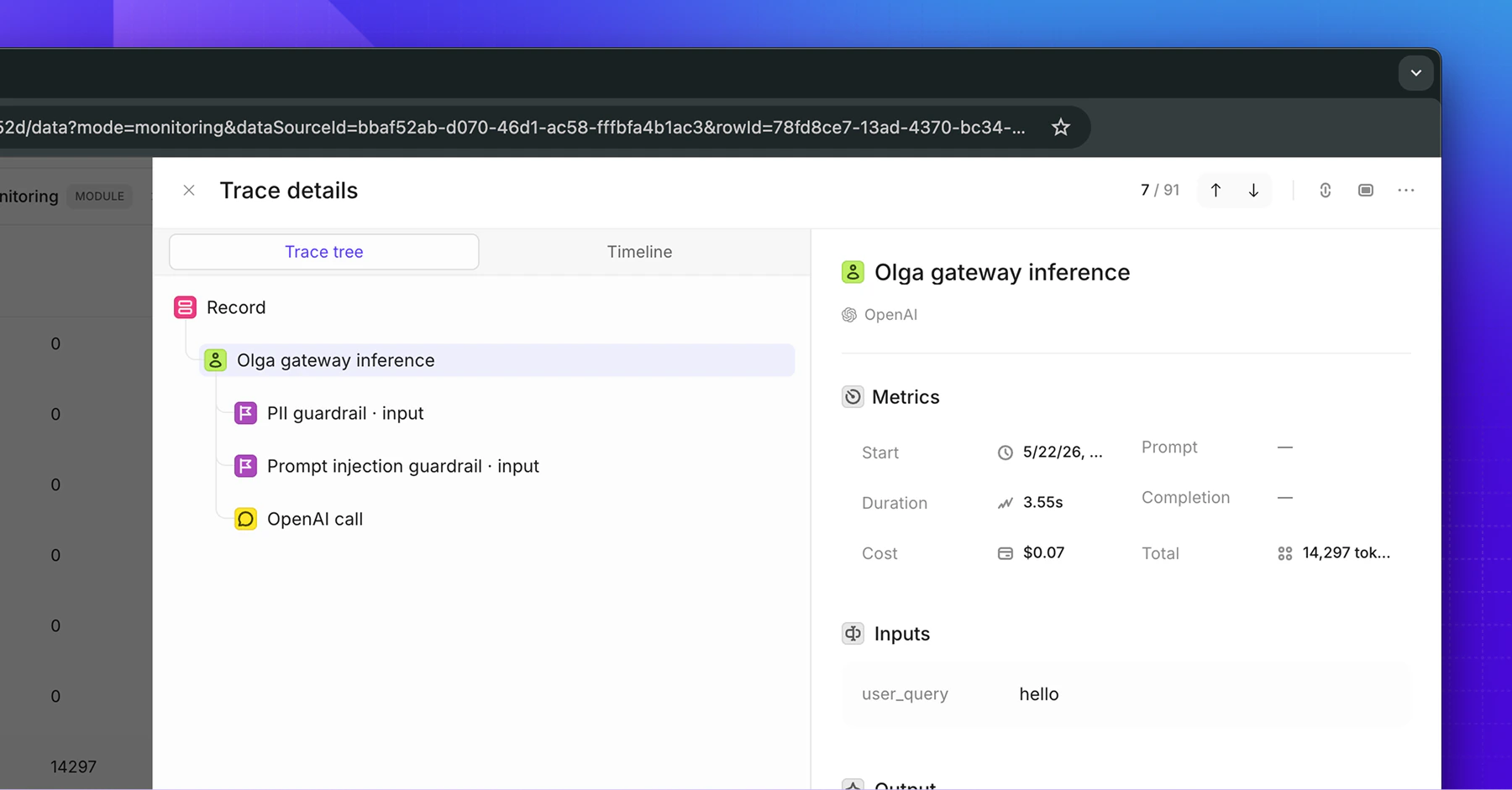
What you get
Everything is configured once, in the gateway’s admin portal. There are no redeploys and no code changes in the apps sending traffic. The portal opens on the Dashboard, where you can see what the whole deployment is spending before going into any one policy.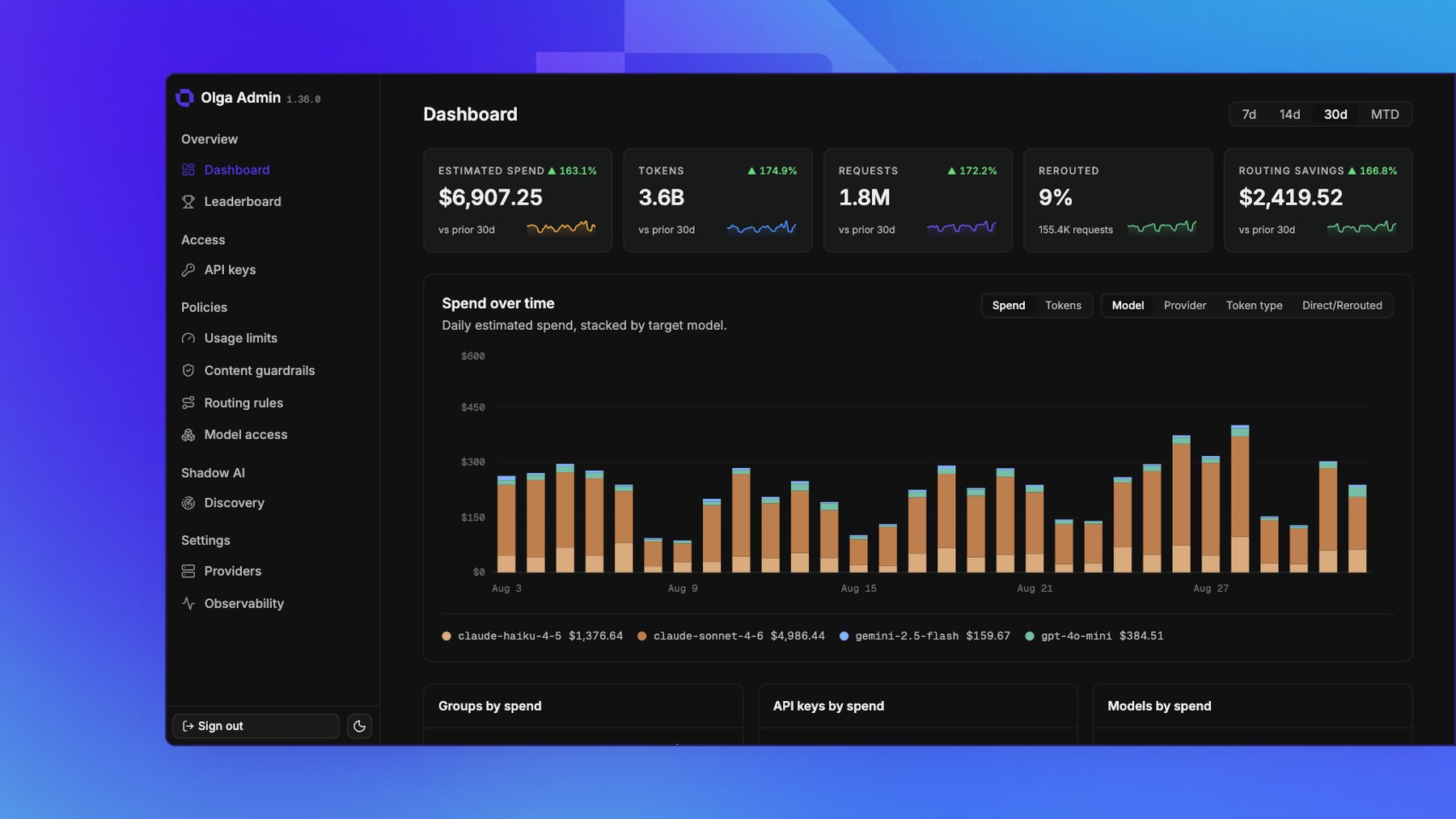
Access & keys
Issue and revoke keys for each app or teammate, assign them to groups, and
hand out self-serve invite links.
Budgets & usage
Cap spend, requests, or tokens per key, user, or group, and see exactly
what’s being consumed and what it costs.
Guardrails
Block or redact PII, stop prompt injection, and screen for unsafe content on
inputs and outputs, before they reach a provider or a user.
Model access
Allow or block models per key, user, group, or the whole deployment.
Providers & models
Connect OpenAI, Anthropic, and Azure upstreams, route traffic between them,
and call any model from any SDK.
FAQ
Do I have to change my application code?
Do I have to change my application code?
Almost nothing. You point your client at the gateway’s base URL and use a gateway key instead of
a provider key. That’s it. Any client that speaks the OpenAI Responses API or the
Anthropic Messages API works unchanged, including streaming.
How is this different from instrumenting my code with the Openlayer SDK?
How is this different from instrumenting my code with the Openlayer SDK?
They serve different jobs and you can use either or both.The gateway exists to enforce your rules on every request, in real time. Tracing comes as a
byproduct: because traffic flows through the gateway, every request is also
published to your Openlayer project without any SDK in your apps. That
makes it the right path when you want governance plus baseline observability across many apps or
languages at one chokepoint.The Openlayer SDK runs inside your code. It doesn’t enforce anything
at the request boundary, but it captures detail the gateway can’t see from outside: nested spans
for retrieval, tools, and sub-calls in a multi-step pipeline, plus any custom metadata. Reach for
it when you need fine-grained traces of how a feature actually runs.A common setup is the gateway for governance and baseline traces, plus the SDK in the places that
need the deeper view.
Is my prompt and response data stored in the gateway?
Is my prompt and response data stored in the gateway?
The gateway forwards traffic. It doesn’t keep your prompts and responses. It stores hashed API
keys, per-day usage tallies, and guardrail event metadata (which guardrail triggered and what
kind of entity, not the underlying text).The full request and response content is sent to your Openlayer project as a trace, where
your data-retention and access controls apply. Openlayer can run on-premises or as
SOC 2 Type II compliant SaaS.
Can I use OpenAI models from the Anthropic SDK, or vice versa?
Can I use OpenAI models from the Anthropic SDK, or vice versa?
Yes. When you route a request to a provider whose format differs from your client’s, the gateway
translates the request, response, and stream between the OpenAI Responses API and the Anthropic
Messages API. See Use any model from any SDK.
Which providers are supported?
Which providers are supported?
OpenAI, Anthropic, and Azure OpenAI / Foundry today. Any provider that exposes an
OpenAI- or Anthropic-compatible API can be connected. See
Connect providers.
What happens if the gateway is sent more traffic than it can handle?
What happens if the gateway is sent more traffic than it can handle?
The gateway caps how many requests it works on at once and keeps a shallow queue for bursts.
Past that, it turns requests away with 503 and a
Retry-After header instead of degrading
for everyone, so a traffic spike costs you the requests it sheds rather than the deployment.This is a capacity backstop, not a policy: it sits well above normal throughput, and it’s
separate from the 429 a usage limit returns. Retrying with
backoff is the right response. The admin portal stays available while it’s happening.